Monday, July 15, 2013

Oglebay Glass Museum

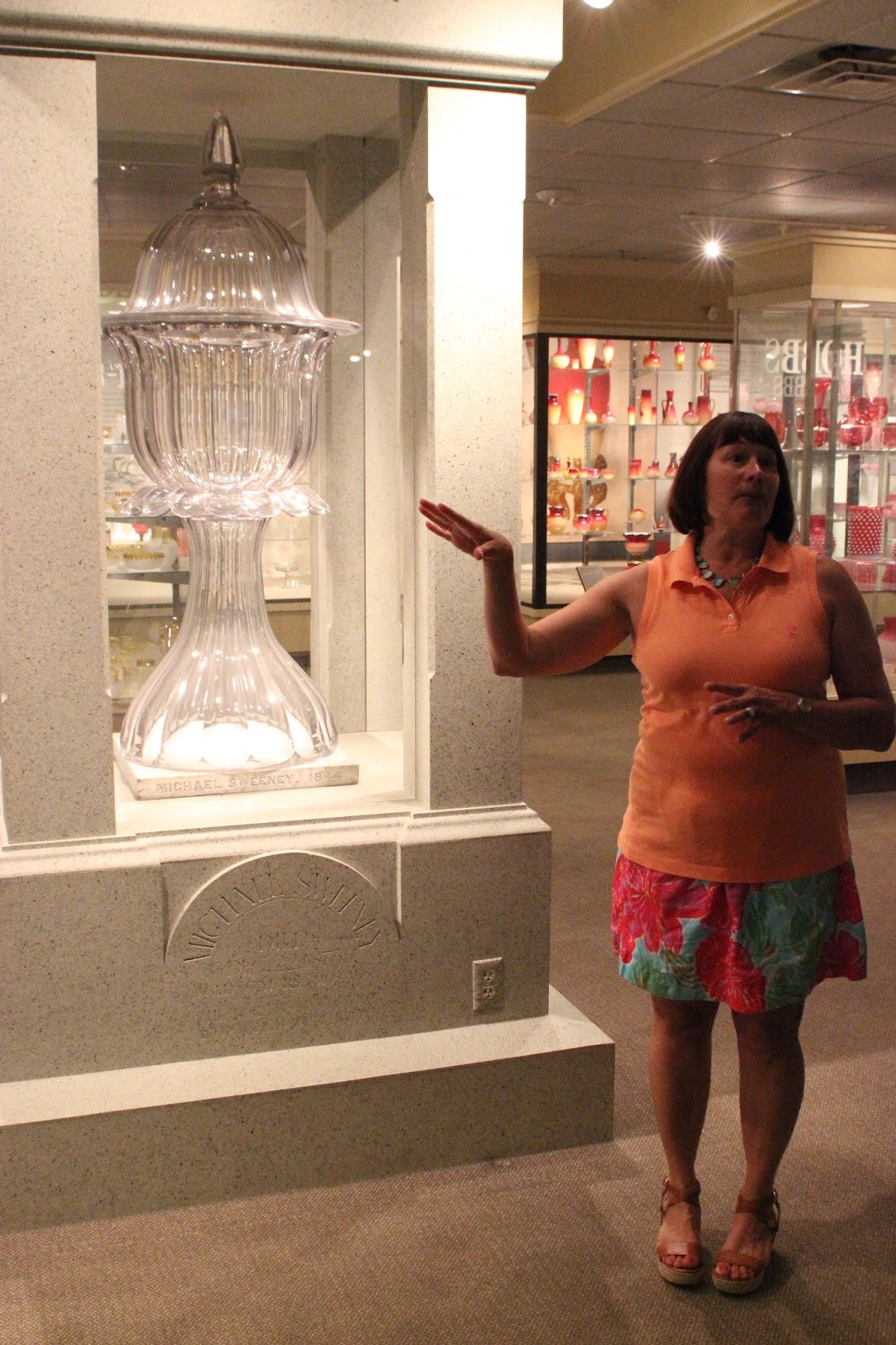
We finished off day one with a trip to Oglebay Glass Museum. The museum was opened in 1993 and its gift shop was filled with West Virginia only glass pieces. Today, due to the loss of glass factories in West Virginia, that is not the case. The accompanying museum is now filled only with works created in Wheeling, West Virginia.


Holly McCluskey, Curator of Glass, gives us the history of the five foot tall glass vase or "punch bowl" as it is known. There were three of them made as traveling display pieces with one of them being given to the Great Orator Henry Clay. This is the last surviving vase. 

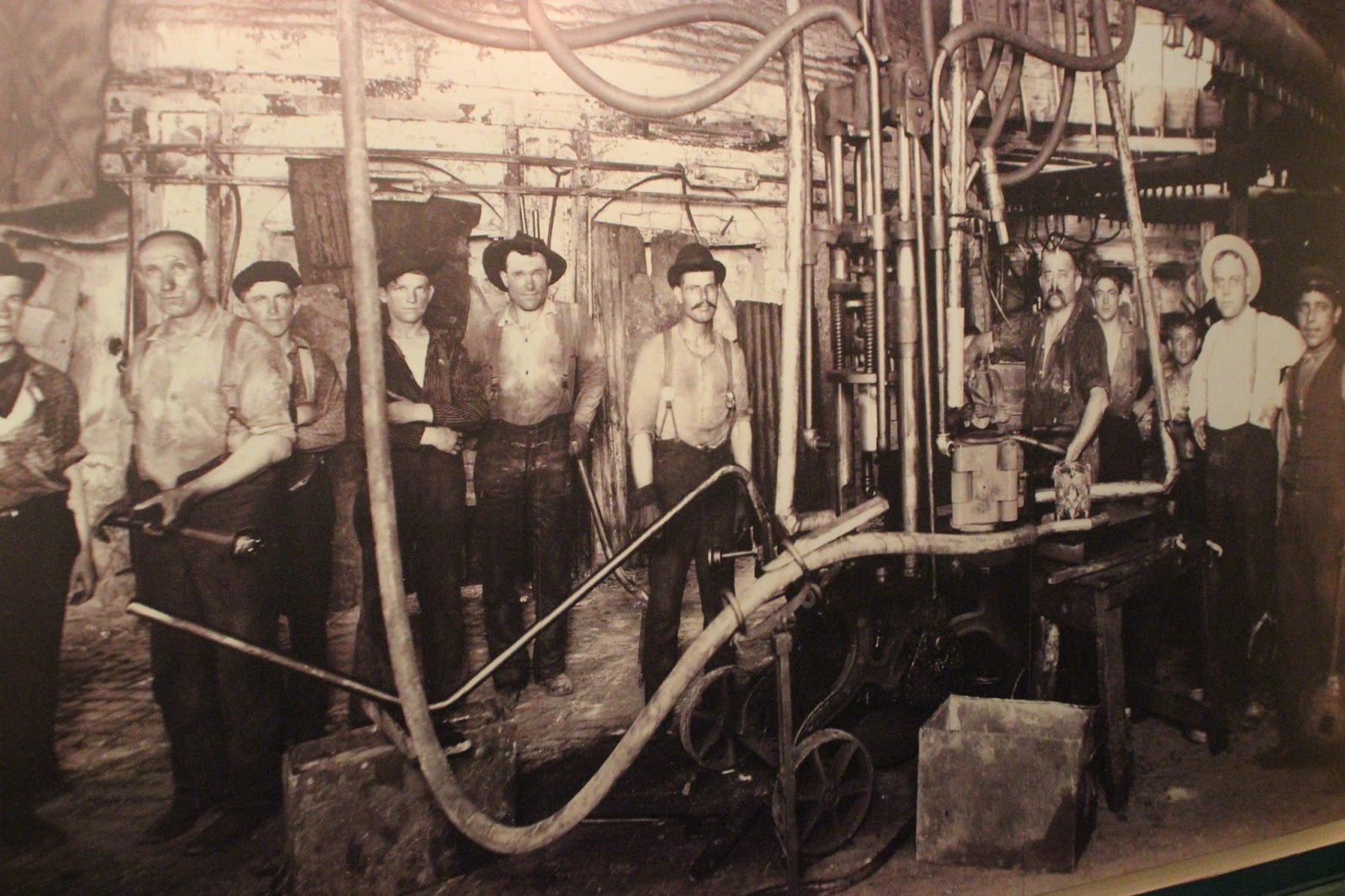
A picture of workers at a glass factory.
  Questions:
1. We see in two pictures here that glass had significance beyond display pieces. Explain how it was used and give any other examples you can think of where glassware might have more significance.
2. Why would a glass producer make a vase that is five feet tall?
3. Are there special considerations in making a vase that large?

Fenton Art Glass

After leaving Gabbert, we headed to Fenton Art Glass to watch the skilled artisans decorate glass.  Fenton no longer produces glass, instead putting painted finishes on the stock they have left and making jewelry and beads from glass stock.

Fenton is located in Williamstown, West Virginia


Artisans meticulously painting glassware.

An artisan examining her work to see what she needs to add to finish the piece.

Fenton's historian discussing the history of Fenton and the chemistry behind glass.
The chemistry of glass

Figurines for sell at Fenton.
Questions:
 1. What are the pros and cons of each piece of glass being hand painted by an artisan?
2. What do you think this means economically?
3. Do you believe a hand crafted piece of art glass is more valuable than a similar piece that is mass produced?

Gabbert Cullett or Bust

We are officially on the trip and learning! We left out this morning at 8:30 and were in Williamstown, WV by 10:30. The weather was dry and hot, but the vans are air conditioned, so no problem.
Our first stop was Gabbert Cullet in Williamstown. Gabbert buys and sells cullet to and from glass suppliers and glass manufacturers.  

The cullet comes in mixed and must be sorted into bins.

The blue cullet here was obviously a fiasco.

Dennis greets the owner of Gabbert, Mr. Frank Lane. Mr. Lane spoke to us about the history of Gabbert.

Broken handles and end pieces from the glass making process.
Questions for consideration:
1. Review the previous posts and define cullet.
2. Mr. Lane's business has been in decline for years because of the number of glass manufacturers that are no longer in business. Why have those businesses been closing?
3. What are some other uses of cullet? Look around your house and neighborhood if you can't think of any.

Monday, July 1, 2013

Blenko's Bountiful Blessings

The Ceramics and Glass Class was blessed with a visit to Blenko Glass in Milton, West Virginia on June 6. Blenko was started by William Blenko in 1893 and moved to Milton in 1921. They hand craft glassware using age-old methods of hand-gathering glass and blowing the molten glass into molds. The only machine they use to make the glass is the ultimate machine, the human body!

Molten Glass inside a oven ready for glass making.
Jason getting his glass ready to blow into a candy dish.

A candy dish being formed by hand by a Blenko artisan.

The molds that glass is blown into are similar to these. They are either made from wood or steel.


Glass cullet ready to be reused in new glass.

Wes is placing his water vase in the annealer. Over a period of about four hours the glass will cool.
The chemistry behind the glass making process was discussed in my Glass Making Chemistry blog entry. Over the course of the day each of our teachers made two water vases and a candy dish. We experienced first hand what is involved in making glass. While we did technically make glass, we couldn't have made anything you would recognize without the help of Blenko's artisans. I'm not sure we could have even created a fiasco without their assistance in fixing our mistakes!

The two water vases that I made at Blenko!
Questions for consideration:
1. Why is it that cullet is used in  glass making?
2. What would be the advantages of using steel over wood molds?
3. How could you overcome those disadvantages?
4. How long does it take to become a skilled glass blower?

Monday, May 20, 2013

Ceramics Explanation and Uses

The term ceramic comes from the Greek word for pottery. It is used to describe a broad range of materials that include glass, enamel, concrete, cement, pottery, brick, porcelain, and chinaware. This class of materials is so broad that it is often easier to define ceramics as all solid materials except metals and their alloys that are made by the high-temperature processing of inorganic raw materials.
Ceramics can be either crystalline or glass-like. They can be either pure, single-phase materials or mixtures of two or more discrete substances. Most ceramics are polycrystalline materials, with abrupt changes in crystal orientation or composition across each grain in the structure. Ceramics can have electrical conductivities that resemble metals, such as ReO3 and CrO2. Ceramics can also make excellent insulators, such as the glass-ceramics used in spark plugs.
Spark Plug Diagram
One of the most distinctive features of ceramics is their resistance to being worked or shaped after they are fired. With certain exceptions, such as glass tubing or plate glass, they can't be sold by the foot or cut to fit on the job. Their size and shape must be decided on before they are fired and they must be replaced, rather than repaired, when they break.

The primary difference between ceramics and other materials is the chemical bonds that hold these materials together. Although they can contain covalent bonds, such as the Si O Si linkages in glass, they are often characterized by ionic bonds between positive and negative ions. When they form crystals, the strong force of attraction between ions of opposite charge in the planes of ions make it difficult for one plane to slip past another. Ceramics are therefore brittle. They resist compression, but they are much weaker to stress applied in the form of bending.
The use of ceramics traces back to Neolithic times, when clay was first used to make bowls that were baked in campfires. Clay is formed by the weathering of rock to form shinglelike particles of alumina and silica that cling together when wet to form clay minerals, such as kaolinite, which has the formula Al4Si4O10(OH)8.
File:Blue and white vase Jingdezhen Ming Yongle 1403 1424.jpg
A Ming Dynasty porcelain vase dated to 1403–1424
Today, ceramics play an important role in the search for materials that can resist thermal shock, act as abrasives, or have a better weight-strength ratio. Alumina ceramics are used for missile and rocket nose cones, silicon carbide (SiC) and molybdenum disilicide (MoSi2) are used in rocket nozzles, and ceramic tiles are used for thermal insulation to protect the Space Shuttle on re-entry through the Earth's atmosphere.

File:Thermal protection system inspections from ISS - Shuttle nose.jpg
Ceramic Heat Shield on botton of Space Shuttle Discovery
Ceramics made from uranium dioxide (UO2) are being used as the fuel elements for nuclear power plants. Ceramics are also used as laser materials, from the chromium-doped crystals that emit a coherent monochromatic pulse of light to the optics through which the light passes. BaTiO3 is used to make ceramic capacitors that have a very high capacitance. It is also used to make piezoelectric materials that develop an electric charge when subjected to a mechanical stress, which are the active elements of phonograph cartridges, sonar, and ultrasonic devices. Magnetic ceramics formed by mixing ZnO, FeO, MnO, NiO, BaO, or SrO with Fe2O3 are used in permanent magnets, computer memory, and telecommunications.

Questions:
1. What are the positive and negative  aspects of using ceramics in industry?
2. Research the Space Shuttle Columbia to find out what happened to it on February 1, 2003. Can you think of another material to use or a way to prevent this from ever happening again?
3. What future uses can you come up with for ceramics?

Source: Purdue University

Monday, May 6, 2013

Blenko Announces 150th West Virginia Birthday Vase

Blenko Glass has announced a special edition vase to commemorate the 150th birthday of West Virginia statehood. West Virginia was carved out of Virginia during the Civil War in 1863. The Herald Dispatch announced the sesquicentennial vase production in today's edition. Blenko will create 150 of the vases for $160 each, available on June 22. Two smaller pieces will also be available to commemorate the event with only 150 of each of them produced.

The Herald Dispatch's article includes the following quote from the designer:
"As I thought about a theme for this important Blenko Birthday piece, my mind kept returning to how West Virginians hold each other in their hearts, to their generosity, hard work and love," said designer Arlon Bayliss, who has designed a number of birthday pieces for Blenko. "The priceless skills of our mold-makers and blowers have led to a remarkable commemorative piece that not only celebrates love, but is made with love, too." 

There will be a special event offered for June 21st and 22nd to commemorate the events, including signings by Walter Blenko and a birthday cake.

Here is a link to the vase's picture and design: http://www.blenko.com/News_and_Events.html

Wednesday, May 1, 2013

Glass Myths Follow Up:Corning Glass Myths

Corning


In researching glass myths I found that corning has posted a fact sheet with several myths about glass. These myths are listed below. Corning goes on to  disprove each of them using technology that they have innovated.

Myth 1 – Glass is for windows
When people think of glass, they tend to think of simple applications, like windows and cookware; but Corning scientists have manipulated glass at the molecular level to take on countless capabilities.
Corning glass makes high speed communication possible through optical fiber, can help turn solar energy into electricity, and enables thinner, lighter, and more durable display devices. Corning scientists continue to expand the capabilities of glass to solve some of the world’s toughest problems.

Myth 2 – Glass smudges
Nobody wants a hand-held device covered in fingerprints. That’s why Corning is developing glass coatings that reduce the appearance of fingerprints and other smudges.

Myth 3 – All glass is the same
After more than 160 years of glass research, Corning holds hundreds of different patents for glass technology. A single element added to glass can significantly change its properties. By manipulating glass compositions, Corning scientists have developed glass that is light, flexible, durable, and even scratch-resistant.

Myth 4 – Glass is heavy
Corning’s photovoltaic glass, about the thickness of a dime, can provide a very light weight solar energy solution while supporting the extra load of a heavy snowfall.
The lightness and durability of Corning® Gorilla® Glass has led to its use as not only a cover
glass, but as an added design element, in products noted for their light weight.

Myth 5 – Glass is fragile
Solar panels have to endure more than just sunny weather. Corning’s photovoltaic glass, for use in solar panels that convert sunlight into electricity, is designed to last for 25-30 years while enduring severe weather conditions. It can withstand hurricane-force winds and severe hail storms.

Myth 6 – Glass doesn’t bend
While most glass doesn’t bend, Corning has several glass products that do. Corning® ClearCurve® optical fiber cable is flexible enough to be stapled and bent around corners, without sacrificing performance.
Corning® Gorilla® Glass, which provides a protective cover for display devices, can be contoured and shaped without sacrificing strength. And Corning’s ultrathin glass can be rolled like sheets of paper and flexed like wire.

Myth 7 – Glass must be thick to be durable
Corning scientists have proven that materials don’t have to be bulky to be durable. Corning has developed cover glass in large sheets measuring less than 1mm thick that can withstand the force of a remote control thrown at 65 mph.

Myth 8 – Glass doesn’t last
Some of the oldest objects in the universe are particles of glass. Astronauts found glass billions of years old in lunar soil. As Corning scientist Dr. Pete Bocko put it, “A glass object will last until the sun blows up.”

Myth 9 – Glass shows every scratch
In a mobile-device market full of plastic and ordinary glass, it is hard to imagine a product resistant to wear. Corning® Gorilla® Glass is chemically strengthened to serve as protection against flaws and scratches. Products designed with Gorilla Glass resist and withstand damage caused by everyday use. Carrying a cell phone in your pocket with keys is no longer a problem.

Myth 10 – Glass is low tech
Corning makes glass tough enough for windows on the space shuttle entering the atmosphere at 25,000 km per hour, clear enough to carry a pulse of light 1000 km, and pristine enough to make an LCD TV with 3 million pixels. Corning glass is anything but simple.

Task:
1.You are to go on an Internet scavenger hunt and find a visual example for at least five of the ten myths that Corning disproves above.
2. Of the ten disproved myths above, which do you believe has the greatest use today? In the future?
Explain.